Busway Systems
Power Busway Systems are manufactured for the transport and distribution of electrical energy from 32A to 6000A.
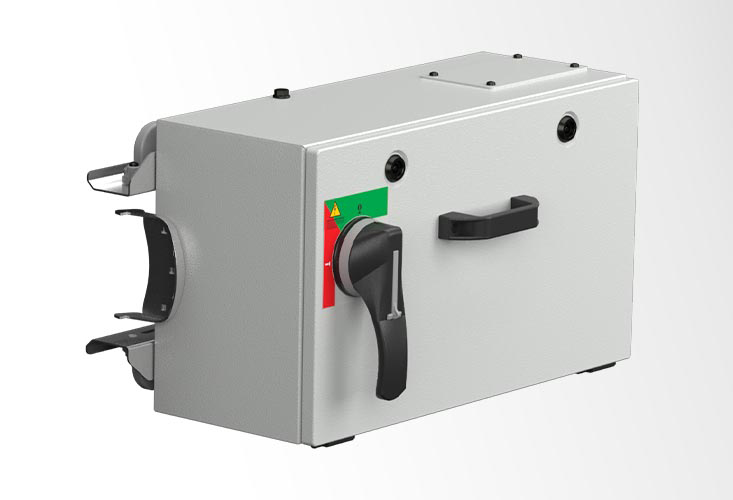 UL/CSA
E-Line KX-III Busway
400A - 6000A UL/cUL/IEC
E-Line CCR-II Busway
400A - 6000A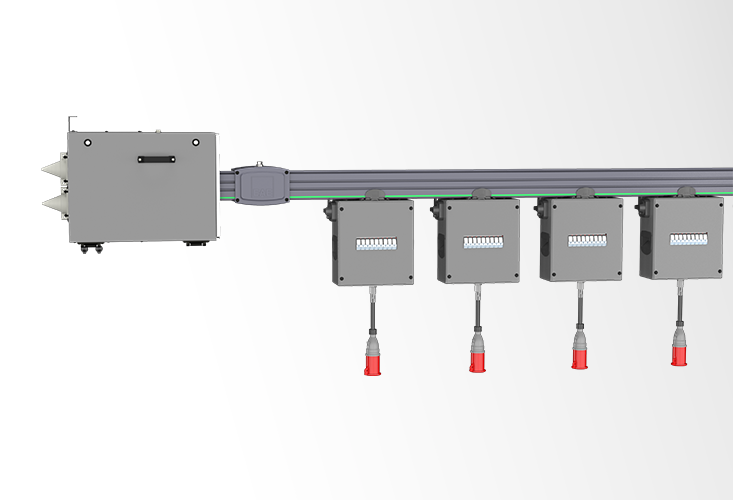 UL/CSA
E-Line KD-III Busway
250A - 800A IEC
IECE-Line KY-S Busway
40A - 63A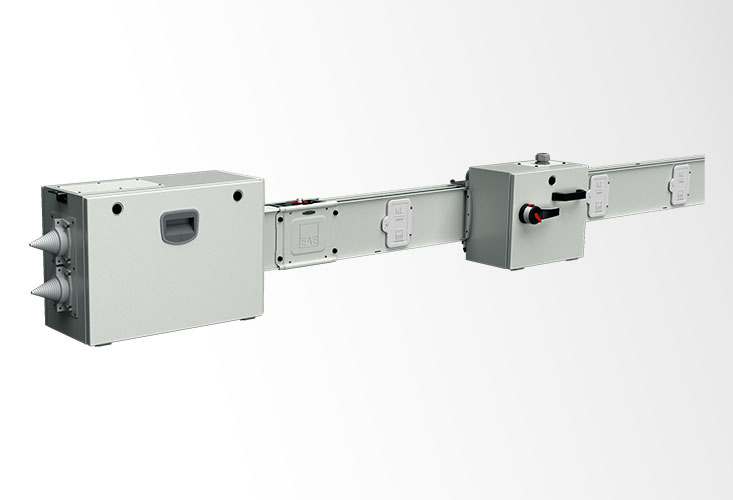 IEC
IECE-Line KL Busway
160A - 1250A IEC
IECE-Line KO-II Busway
160A - 800A IEC
IECE-Line MK Busway
100A - 250A IEC
IECE-Line DL-SL Busway
40A IEC
IECDabline Busway
63A - 80A IEC
IECE-Line KAP Busway
40A - 63A IEC
IECE-Line MV Busway
950A - 5000A IEC
IECE-Line CR Busway
630A - 6000A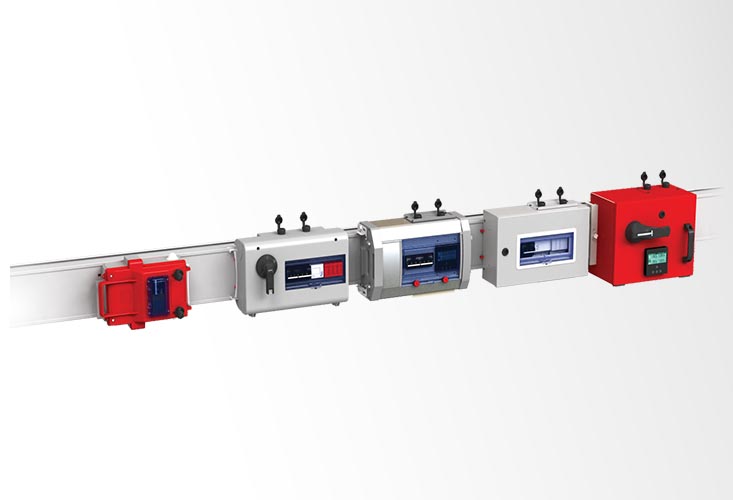 IEC
IECData Center Tap-Off Boxes
80A - 400APower Busway System
Power Busway System is a modular energy transmission and distribution system created by insulating current carrier Aluminium or Copper busway conductors placed in a closed body. The busway system is used to transmit energy to a point along the route within the facility, starting from a point such as a transformer, generator or panel, or to distribute energy to the loads in the facility by receiving energy from the current receiving points on it with tap off boxes.
Frequently Asked Questions
What is a busway (bus duct) system?
Busway (also known as bus duct) is a modular power distribution system consisting of insulated copper or aluminum conductors enclosed in a protective metal housing. It transmits electrical energy from a transformer, generator, or panel to various points within a facility.
Energy is distributed through tap-off boxes that can be plugged in along the busway route. EAE busway systems, manufactured since the 1970s, are available in ratings from 25A to 6000A, making them ideal for industrial facilities, data centers, and infrastructure projects.
What is the difference between air insulated and compact (sandwich type) busway?
Air insulated busway has gaps between conductors, relying on air for insulation. It is suitable for lower-range applications (25A-63A with insulated sheaths, 100A+ with post insulators).
Compact or sandwich type busway (bus duct) wraps conductors with insulation materials (polyester film with epoxy coating) and places them without air gaps, providing higher current density, lower impedance, and better short-circuit performance. EAE's KX-III Busway series uses compact technology.
What current ratings are available for EAE power busway systems?
EAE USA Busway Systems: The E-Line KX-III for high-power applications in the 400A–6000A range, the E-Line KO-II for medium-scale distribution, the E-Line MK for small-scale industrial use.
What is a data rack busway and how is it different from busway?
Data rack busway (like EAE's KD-III) is specifically designed for power distribution within data center white space.
Unlike traditional busway, it features an open channel design optimized for rack cabinet rows, vendor-neutral tap-off boxes with energy monitoring capability, plug-and-play installation, and the ability to add/remove/relocate tap-off boxes while energized.
It replaces traditional whip cabling for more flexible and scalable power delivery.
What is the difference between compact (sandwich) and air-insulated busway?
Air-insulated busway has gaps between conductors, using air as the insulating medium. It is suitable for lower current applications.
Compact or sandwich-type busway wraps conductors tightly with insulation materials (polyester film with epoxy or polypropylene coating) with no air gaps between them.
Compact busway provides higher current density, lower impedance, better short-circuit withstand, and smaller physical size. EAE's E-Line KX-III series uses advanced compact technology for ratings from 400A to 6000A.
What is the difference between bolt-on and plug-in busway?
Bolt-on systems are those where energy can be taken via tap-off box through connection points. KX-III Busway can be both bolt-on and plug-in.
Plug-in systems are those where energy is taken from plug-in point along the busway. In the KO Busway, energy can only be taken from plug-in window points.
Bolt-on busway allows power tap-off only at the joints between sections using bolted connections. Plug in busway has openings (plug-in windows) along the entire housing length, allowing tap-off boxes to be installed at any point along the run.
Plug-in offers greater flexibility as power distribution points can be added, removed, or moved without system shutdown, making it ideal for facilities with changing power needs.
When should I use cast resin busway instead of standard busway?
Cast resin busway systems are used in outdoor conditions or in environments requiring environmental resistance (such as tropical climates, chemical environments, or areas with insects and pests), thanks to their IP68 protection class.
What is DURACOMP in EAE CCR Busway?
Aluminium body over the IP 68 “DURACOMP” composite material that is made by specially selected pure silicium minerals and epoxy resin and has high temperature and mechanical operation features protects E-LINE CCR busway (cast resin busway) from external elements.
What are the Advantages of Using a Busway?
The advantages of Busway System compared to Conventional Cable Distribution Systems:
- As the current requirement increases, the demand can be met by adding to the busway system. However, cable sizes are limited in cable systems, and more than one cable may be needed to achieve the equivalent capacity of a busway system.
- Busway systems have a shorter installation time than cable systems.
- Busway systems offer greater mechanical strength compared to cables.
- Due to its modular structure, the busway trunking system can be dismantled, transported, and re-assembled in another area for reuse.
- The busway disperses the heat generated during electricity transmission and distribution to the external environment effectively.
- The body of the busway system, made from hardened aluminum profiles or galvanized sheets in accordance with TS 822 standards, is highly impact-resistant.
- Energy loss during transmission and distribution is significantly lower in busway systems compared to cable systems.